Construction has begun in the Graubünden municipality of Albula/Alvra for an exploratory tunnel, which explores the possibility of technically renovating the “Brienz slide”. Numerous underground test holes are drilled out of the tunnel. The results of the tests are expected in spring 2023.
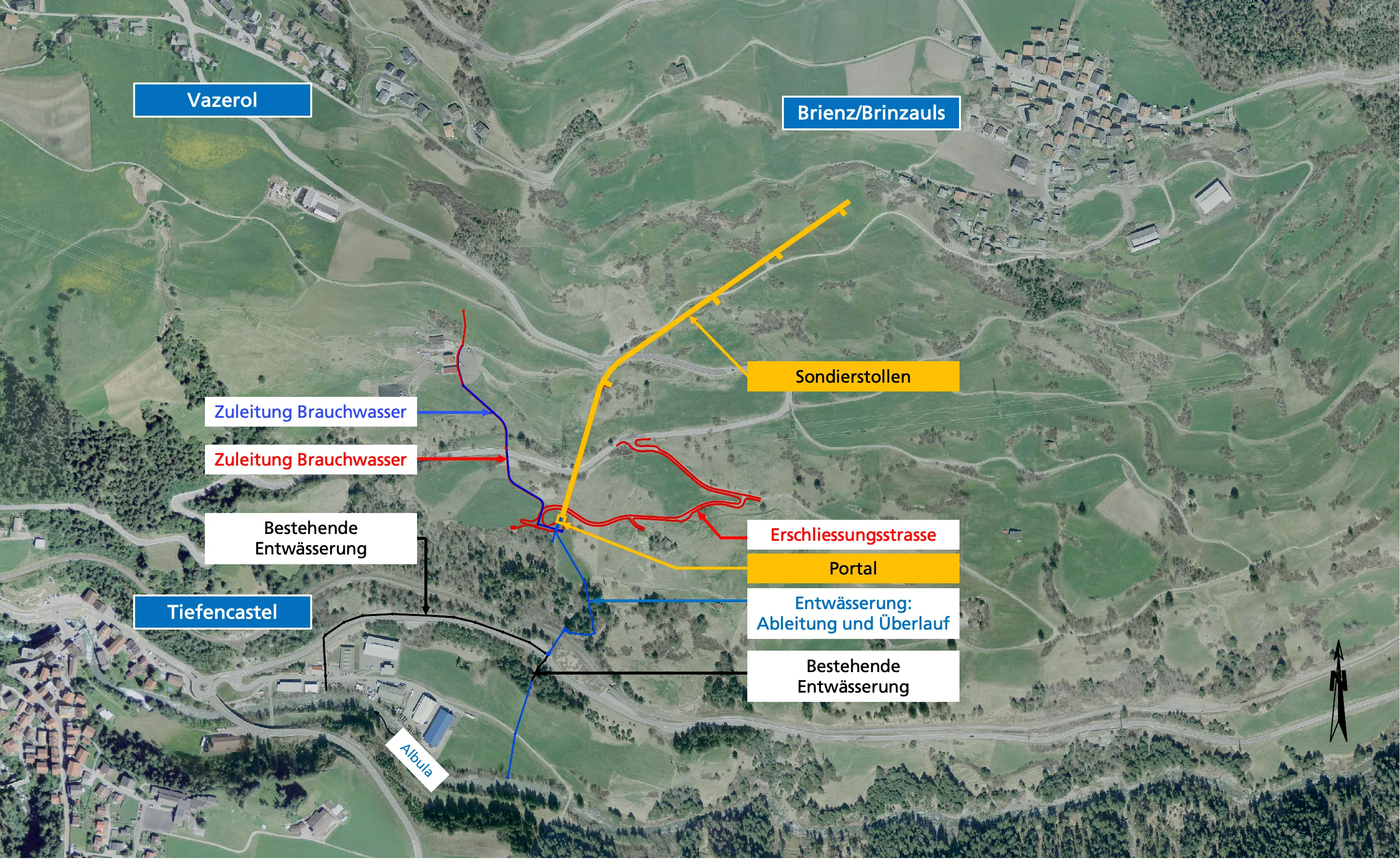
The Graubünden mountain village of Brienz/Brinzauls is exploring the possibility of slowing down or even stopping one of the biggest landslides in Switzerland through deep drainage. Preparatory work for the construction of a 600 meter long exploratory tunnel began on Monday.
It will be blown into the stable rock bottom below the landslide and is expected to cost around 10.5 million francs. 90 percent of it is supported by the Canton of Graubünden and the federal government. The municipality of Albula/Alvra and various owners of traffic routes and lines through Brienz Rutsch together bear 10 percent of the costs. Talks are ongoing about dividing them up.
From the sounding tunnel, numerous holes are drilled sideways into the solid rock under the landslide and upwards into the slippery mass above. They should divert water from the mountain and provide information about the geological conditions in the mountain.
Geologists hope that drainage can slow down or even stop the landslide. If the exploratory tunnel is successful, it will be extended in a second construction phase and expanded into a permanent drainage tunnel, which can stabilize the area in the long term.
Great hope for those affected
“For the population, the exploratory tunnel is the great hope that they can still master the landslide that threatens their village,” says Mayor Daniel Albertin, describing the mood at the start of construction. “The start of construction marks an important milestone in the efforts of the municipality of Albula/Alvra and the Canton of Grisons for the affected inhabitants of the villages of Brienz/Brinzauls, Vazerol, Surava and Tiefencastel.”
The water and energy supply, an access road and the tunnel portal area will be built first by the end of August. This is when mining begins, which will take about a year.
Whether the exploratory tunnel is successful is being investigated with several dozen boreholes and measurement stations. “We are monitoring the slide area in great detail, which allows us to quickly identify the effects of the exploratory tunnel with its underground test holes,” explains project manager Josef Kurath from the Graubünden Civil Engineering Department. “In spring 2023, we will be able to make the first statements as to whether the exploratory work is having the intended and hoped-for effect.”
Brienz Slip
In Brienz Rutsch, an area of around three square kilometers with the entire village of Brienz/Brinzauls as well as roads, a railway line and numerous power and data lines moves down the valley more than one meter per year. As a result of the landslide, more and more buildings are being damaged, so that the village could become uninhabitable at some point.
At the same time, there is a risk of a rock slide from the lower southern flank of Piz Linard, which could possibly reach Brienz/Brinzaul and parts of Vazerol, Surava and Tiefencastel.
The municipality of Albula/Alvra, to which the four villages belong, and the canton of Grisons formed an extensive pension organization in 2018, which is concerned about the safety of the affected area, its residents and the infrastructure. The work of the various project groups is coordinated with the infrastructure operators in the area and the affected residents are involved.
Christian Gartmann has been Communications Officer for the Municipality of Albula/Alvra for Brienz Rutsch and a member of the municipal management staff since 2019.