After a voluntary break, JU-AIR resumed flight operations on Friday with a flight to Germany. It has met all requirements of the Federal Office of Civil Aviation and has taken additional measures itself to guarantee safe flight operations. At the beginning of the first flight day, there was a minute of silence and the airplanes wore a mourning pile.
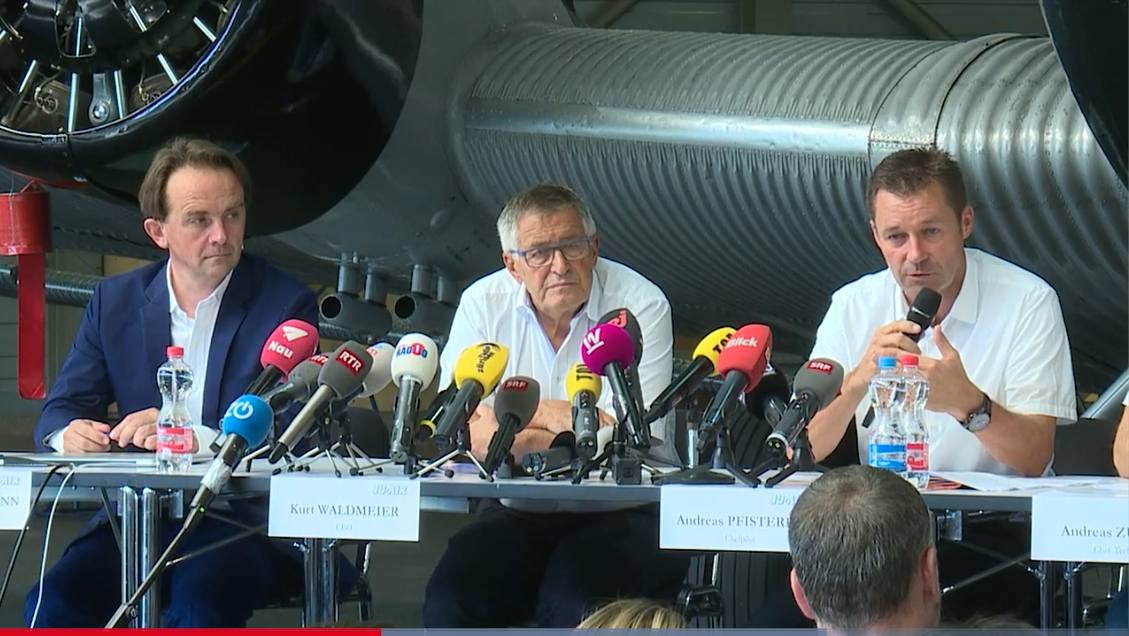
“On August 4, a new era began for JU-AIR,” CEO Kurt Waldmeier opened the media conference after a minute's silence. “When we look back on the history of JU-AIR from today, we will always think of the 17 passengers and our three crew members that we lost so tragically.”
JU-AIR had used the time of the flight interruption to intensively care for its crew and the two remaining aircraft. “I've been talking to our team a lot since the accident. I therefore know for sure that our technical and aircraft experts are ready. Our JU-52s are safe and so is our flight operations.”
Waldmeier also had many discussions with members of the injured crew and passengers. Relatives had praised the voluntary interruption of operations, said Waldmeier. JU-AIR was also encouraged to fly again, not least from its circles.
“Fit to Fly”
On Thursday, the Federal Office of Civil Aviation FOCA published a series of measures that had to be implemented to resume flight operations. “We implemented everything, after all, we had even proposed most of it ourselves,” said Chief Pilot Andreas Pfisterer. “As long as you don't know what caused our aircraft to crash, it's good to add an additional safety margin at the appropriate points.” JU-AIR Chief Technology Officer Andreas Züblin explained the intensive maintenance of the almost 80-year-old aircraft.
“We check all important parts of the aircraft in precisely defined cycles and have carried out additional checks over the past few days. This did not reveal any special features. Our two JU-52s are “fit to fly” without any restrictions.”
“Historic, former military aircraft have special requirements when it comes to long-term maintenance,” explained JU-AIR engineer Tobias Koch. Together with the Federal Office of Civil Aviation, the Zurich University of Applied Sciences and other operators of classic military cars, JU-AIR is therefore advancing the “Ageing Aircraft” research program.
The aim of the project is to develop long-term maintenance programs for these special machines. JU-AIR's technology is highly regarded internationally in this area.
Airplanes with weeping pile
The grief for the 20 victims of the accident is felt and visible in Dübendorf on the first day of flight. The two aircraft are wearing a mourning pile. On Thursday evening, around 140 members of the injured crew and volunteers from the JU-AIR Corps took part in a memorial service for the victims of the plane crash.
At 4 p.m., one of the aircraft will take off for Bensheim in Germany. It is flown by chief pilot Andreas Pfisterer and German captain Uwe Schmuck. The one-hour sightseeing flight planned for 6:30pm had to be cancelled due to predicted thunderstorms.
Contact JU-AIR
Christian Gartmann, Communications Officer
+41 79 355 78 78
christian@gartmann.biz
Christian Gartmann has been supporting JU-AIR in crisis management and crisis communication since the day of the accident. Comprehensive and transparent information for the public and communication with the families of the victims are at the heart of the efforts. Christian Gartmann acts as media spokesperson for the airline and actively supports media professionals in their individual editorial work.
He supports company management in communication with relatives of accident victims, for example when implementing memorial events.
To resume flight operations, a media conference was held for almost 50 media professionals from Germany and abroad.