A clear stance and positioning of regions and companies is crucial for successful health tourism in the Swiss Alpine region. At the “Health & Tourism” conference, experts from five countries called for long-term decisions to be made and also to take risks. Almost 150 participants came to Pontrtesina on Wednesday to learn about the potential of health tourism and its success factors for the Alpine region.
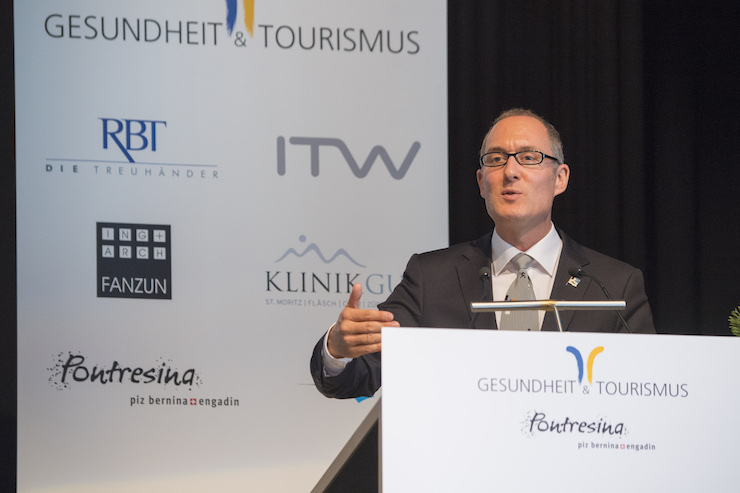
The establishment of new health tourism in the Swiss Alpine region requires clear commitments from tourism and healthcare policy, administration and companies. Experts from five Alpine countries came to this conclusion at the 2nd “Health & Tourism” conference in Pontresina. Grisons Regional President Christian Rathgeb called on the regions to support local projects. “We should do everything we can to promote new things and not just complain about the framework conditions,” he said.
Rathgeb promised that the canton would work to ensure that the considerable potential of health tourism for Grisons could be realized by companies. The government will very quickly appoint a working group to develop concepts and strategies for the canton and its regions.
The development of a successful offer in a region requires a variety of collaborations, said Philipp Gunzinger, who was responsible for the development of the Lower Engadine health region. This is the only way to professionally connect and market medicine and tourism. Gunzinger is to head the working group of the Canton of Graubünden.
If a holiday region also wants to become a health region, “pioneers of networking” are needed, confirmed tourism developer Prof. Harald Pechlaner. The South Tyrolean called on regions and companies to differentiate themselves and create precisely profiled products. Just standing for the issue of health is not enough. Integrated concepts that include all the strengths of a region are required.
Central point of contact for guests
Up to five times higher added value and a longer length of stay made health tourism guests attractive to Grisons, emphasized the new CEO of Grisons Holidays, Martin Vincenz. He used his first public appearance to suggest the creation of a Graubünden contact point which would assist health tourism guests in planning and booking their stays.
This advice should definitely not be missed, Heidi Thaumiller also underlined. The tourism director of Oberstaufen im Allgäu emphasized that medical assistance is the “be-all and end-all” of every health stay. Daniela Krienbühl announced that the resort under construction on Bürgenstock is hiring around 50 medical specialists to provide medical care for its guests. The operations manager of the Waldhotel Bürgenstock health hotel was convinced that the major project had an impact on the whole of Switzerland and was thus also helping other regions in the Swiss Alps to position themselves as health destinations.
All experts repeatedly pointed out the importance of a clear positioning of offers. Tourism consultant and hotelier Jakob Edinger underlined that wellness and medical tourism are “two different worlds.” Wellness is driven by the hotel industry, health tourism by the medical side. Lanserhof, which has been successful in Austria and Germany for 30 years, is therefore relying on a very consistent medical service concept, Lanserhof managing director Nils Behrens agreed. Every company must decide what it stands for and how it differs from other providers.
Premiere in St. Moritz
The “Santasana St. Moritz” project for heart rehabilitation in high-altitude climates was presented to the public for the first time. On the initiative of former heart patient Viktor F. Fässler, hotels and health professionals in St. Moritz will be offering outpatient rehabilitation for heart patients from next year. Managing Director Christoph Schlatter said that they want to care for around 200 patients in their first year. They are to live in three St. Moritz hotels and thus generate around 10,000 overnight stays. Heart rehabilitation in high-altitude climates is a novelty in Europe, but several studies prove its effectiveness. The healing successes of patients in St. Moritz will also be evaluated as part of a scientific study.
In addition to presentations and panel discussions, the conference also offered time and space for personal discussions. “Something new should be created at this conference,” says organizer Christian Gartmann. “Networking and personal exchange of experiences are extremely important here.” The Santasana St. Moritz project shows that projects can actually be created in this way. “Last year's conference gave a significant boost to the idea,” says Gartmann. “I hope to see something here again next year that started here today.”
Current images from the conference are available for download free of charge
www.bit.ly/2D97b4r
Password: gtgr16
contact
Christian Gartmann, initiator and host
079 355 78 78