New access and water pipe for Bondo — Calming down at Pizzo Cengalo — opening of Maloja Street even at night
Bondo is getting a new, safe access road and a new supply line for drinking water. The risk of further landslides and debris flows has declined somewhat and thanks to an additional safety system, the cantonal road is now accessible again even at night. The municipality and its partner organizations are doing everything they can to stop the evacuation of Bondo, Spino and Sottoponte as soon as possible.
Situation overview one month after rock slide and first debris flows
One month after the rock slide on Pizzo Cengalo and the first debris flows to Bondo, the village has a new, safe access road. Army units of genius have begun preparatory work this week for the construction of a single-lane bridge from the new cantonal road to the plain west of Bondo. From there, an existing dirt road will be temporarily extended to the access road to Bondo.
The new access road is to be opened in around three weeks. Residents and visitors can use them to reach Bondo without having to travel through the “red zone” threatened by every next debris flow.
Safe access is one of the prerequisites for lifting the Bondos evacuation. In addition, the power supply, the sewage network and the supply of drinking water must also be restored. Since Bondo's water supply from Val Bondasca has been destroyed, an additional water pipe must be built from Stampa to Bondo. The core of the new pipeline will be an aqueduct across the Val Bondasca gorge exit.
The municipality and ewz are also building a new power supply line for the hamlet of Spino. To do this, a trench several hundred meters long must be pulled.
It is not yet possible to say in more detail when the evacuation of the various districts of Bondo, Spino and Sottoponte can be lifted. In addition to the infrastructure projects mentioned above, the emptying of the Maira catchment basin and riverbed must have progressed to such an extent that even a major debris flow no longer directly threatens any districts.
Calming down on the mountain
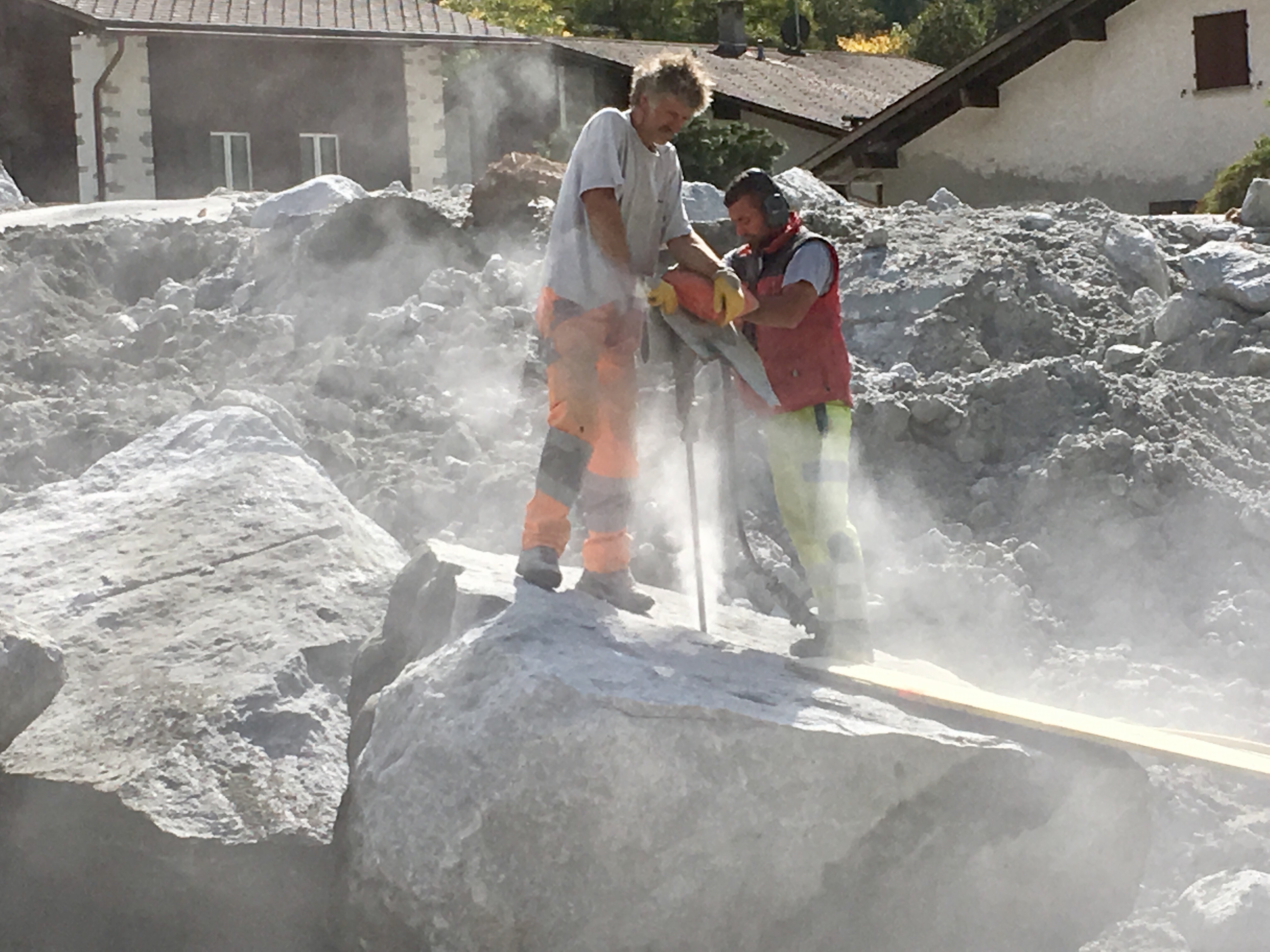
Recent measurements have shown that the debris flows had brought almost half a million cubic meters of material down to the valley floor by August 31. So far, around 80,000 cubic meters have been excavated and transported to the two landfills west of Bondo.
In the meantime, the situation at Pizzo Cengalo has calmed down somewhat. Laser measurements have shown that around 400,000 cubic meters of rock crashed into Val Bondasca during the last rock slide on September 15. With this third-largest rock slide after 2011 and August 23, the material, which was at risk of an acute fall, has almost completely crashed and movement in the critical areas has fallen from 5-8 cm to a few millimeters per day. However, further rock breaks must be expected at any time.
The risk of debris has also fallen somewhat. The cold weather reduces the amount of meltwater from the glacier and precipitation falls mostly as snow. Unfortunately, the all-clear cannot be given here either; especially in the event of renewed warming and heavy rain, debris flows down to the valley floor are still possible at any time.
Improved alarm allows the cantonal road to operate at night
An additional alarm system was installed last week in order to improve alerting when debris flows into the Bondo area. It hangs on cables across the Bondasca River about 2.5 kilometers above Bondo. If the river swells or a new debris flow, it ensures an alarm even at night and in poor visibility, which enables an evacuation time of four minutes in the retention basin near Bondo and on the old cantonal road.
This improvement in alerting now also allows the old cantonal road to be operated in the dark. The night closure of the H3 main road through Bergell was therefore lifted on Monday. Traffic is still routed along the old cantonal road through Spino and Promontogno. Waiting times of between 10 and 30 minutes can still be expected at traffic lights.
It is not yet clear when the new cantonal road through the Promontogno tunnel can be reopened. Only when the bridge over the catchment basin is completely exposed can it be examined in detail for damage. In addition, the road west of the town entrance to Bondo was washed over a length of around 200 meters.
The repair will definitely take several weeks. The municipality of Bregaglia and the cantonal authorities supporting it are doing everything they can to ensure that this important thoroughfare can be opened to traffic again for the 2017/2018 winter season.
Great solidarity
The amount of damage to public and private infrastructure and the damage suffered by private individuals and companies as a result of the rock slide and debris flows cannot yet be quantified. Estimates are only possible when the objects affected by the debris flows can be safely walked on and removed.
However, it is already clear that the damage to community infrastructure is in the millions. Clearing the collection basin alone costs tens of thousands of francs every day.
The fortune chain has raised 4.3 million francs by the weekend and the sponsorship bond fund for mountain communities already amounts to 1.3 million francs. Around 1.9 million francs have arrived in the municipality's collective account.
Numerous private individuals and organizations have offered their help with the clean-up work. But it is still too early for that; staying in the affected areas is still too dangerous. The municipality of Bregaglia registers all offers of help and later regains the commitment. She would like to thank all donors and aid organizations for their great solidarity.
Christian Gartmann is supporting the municipality of Bregaglia in crisis communication following the rock falls and debris flows in summer 2017. He is a member and spokesperson of the municipal management staff (GFS).