The rescue work for the historical source version has begun in St. Moritz. The wooden spring frame from the Bronze Age was lifted out of its anchorage during the flood on Sunday and damaged.
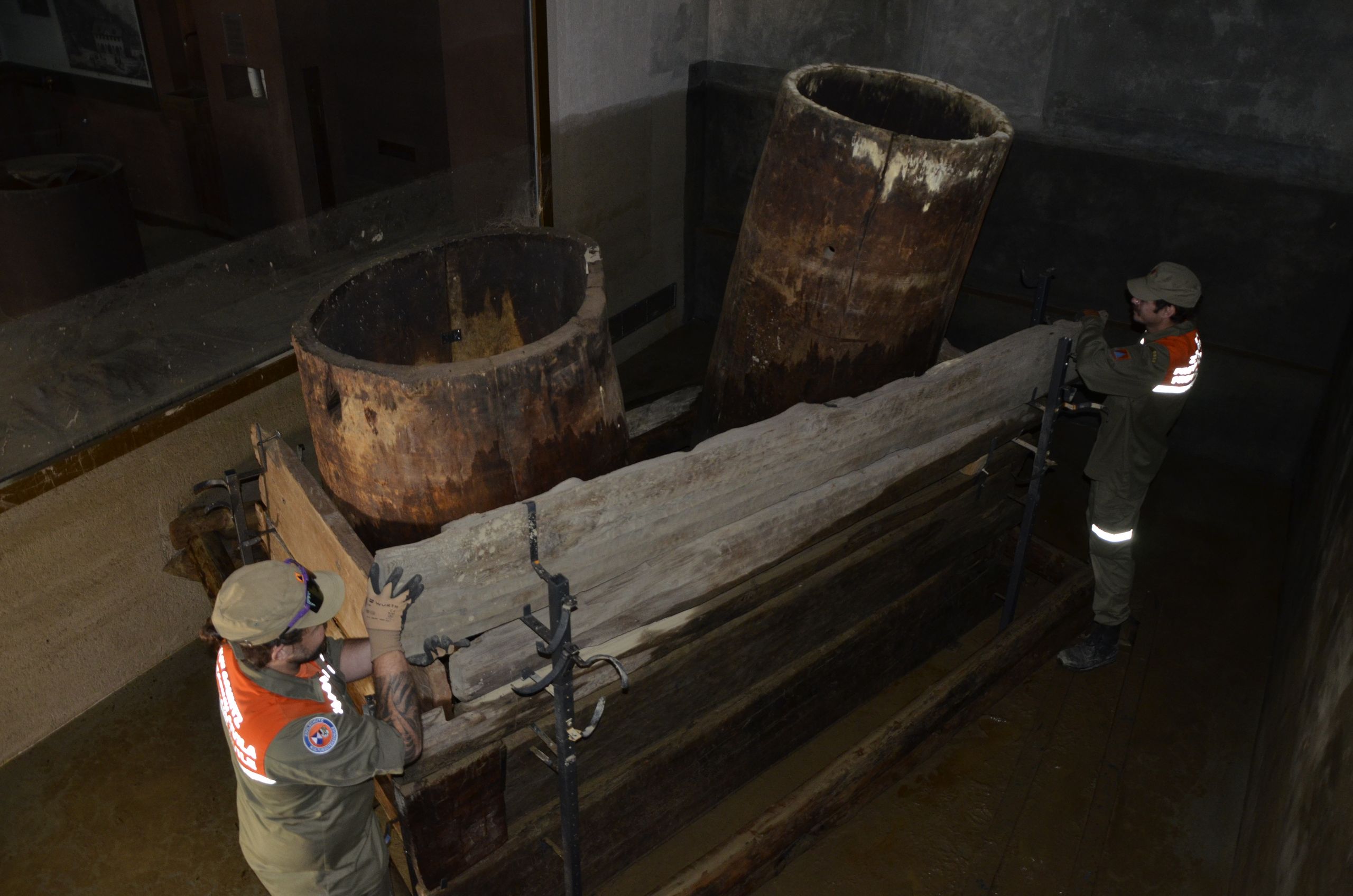
Since Tuesday, experts from the Grisons Archaeological Service and the Protection of Cultural Property in Grisons Civil Protection have been dismantling the components of the source version, documenting their condition, cleaning them and bringing them to a dry storage location. It is planned that they will be exhibited there again after the renovation of the Forum Paracelsus in St. Moritz-Bad. Before that, it will be examined what a future flood hazard looks like. The floods of the “Ovel da Tegiatscha” mountain stream had submerged Forum Paracelsus up to 170 centimeters deep on Sunday.
The historical source version is exhibited there in an air-conditioned room. It consists of three hollowed-out logs as well as beams and thick larch wood boards. As the water penetrated the room, the wood floated and was damaged in the process. It is not yet possible to say how severe the damage to the approximately 100 parts of the source version is.
Two specialists from the Archaeological Service and seven specialists in cultural property protection from the civil protection of Grisons are involved in recovering the historical source version. Six civil defense specialists joined the team for this purpose at short notice.
The rescue work is expected to last until Friday.
An important relic of tourism in the Alpine region
The source version of the St. Moritz Mauritiusquelle is almost 3,500 years old. It was made in 1411 BC from the trunks of larch trees that are several hundred years old. The hollowed logs were buried in the ground near today's Hotel Kempinski. The water from the spring was then collected in the hollow logs. They lay in the bog soil for around 3,300 years before they were excavated in 1907 and examined with the latest means and dated more precisely in 2013.
The St. Moritz healing springs are the oldest and highest healing springs in the Alps. They marked the beginning of tourism, because already in the Bronze Age and then in the Roman Age, well-heeled guests from all over Europe traveled to St. Moritz to drink or bathe in the healing water. The source version, which is now being saved, is probably the oldest relic of early tourism in the Alpine region. It is therefore a cultural asset of international importance.
Ovaverva Sports Center is open again
In the neighboring Ovaverva sports center, penetrating water on the lowest floor had damaged some technical equipment and left a layer of very fine sand in cloakrooms, showers, corridors, the main entrance and a fitness room. It was difficult to clean the rooms, but the center was able to reopen on Wednesday. The flood had damaged, among other things, the pumping system of the water slides, but not the entire technology. Some electronic systems also had to be serviced.
The water slides will not be operational for some time, and the fitness center is expected to reopen later this week.
Press release from the municipality of St. Moritz dated July 10, 2024.
Christian Gartmann supported the municipal management staff and the municipality of St. Moritz in communication work on the floods of July 7, 2024 and in coping with their consequences.