Within just six months, a team of experts developed the exploratory tunnel project under Brienz slip. After numerous drilling, measurements and tests, it should show over the next one and a half years whether a longer drainage tunnel could slow down or even stop the Brienz slide. Daniel Figi is responsible for the geological studies.
The following interview was conducted in Brienz slip information bulletin dated February 15, 2021 published.
On February 7, the population approved the credit for the exploratory tunnel. When does construction start?
If everything goes well, we can start construction on May 31. First, the access road to the tunnel portal is extended and then the installation site and pre-cut are created. The actual tunnel drive starts at the end of August.
How did the idea of using a tunnel to renovate the Brienz slide actually come up?
We looked around the world and saw that there are several landslides in Switzerland and abroad that could be repaired with a drainage tunnel. So the idea is not new. With the planned exploratory tunnel, it is now being checked whether drainage through a tunnel can also work during Brienz slip.
Can Brienz slide be compared with other slides?
Each slide is unique in itself. In terms of its dimensions, the Brienz slide in Switzerland can best be compared with the landslide of Campo Vallemaggia in Tessin, but there is a different geology there.
If we look at the rocks, the Brienz landslide is similar to the La Frasse landslide in the canton of Vaud. There are also flysch rocks typical of slide areas. But the large Bündner slate landslides on Heinzenberg and in Lugnez also have certain similarities with the Brienz slide.
“Nature puts us under time pressure.”
What is different about Brienz slide than other slides? What makes him stand out?
At the moment, it is certainly the high sliding speed. No other slide in the residential area of Switzerland, which is nearly as large, is moving as fast. It is also special that Brienz/Brinzauls is simultaneously endangered by various processes. The entire village moves downhill at a rate of more than one meter per year and at the same time, a rock slide event from the rock masses above the village cannot be ruled out.
Compared to other tunnels or tunnels in the Alps, the studies and preparation for the exploratory tunnel took only six months. Why was it so fast?
In contrast to a road or rail tunnel or a power plant tunnel, our probe tunnel is not a permanent structure that is built to last 90 years. During planning, certain planning steps can therefore be left open or they can be omitted altogether.
But nature also puts us under time pressure: Because landslides and a possible rock slide threaten Brienz/Brinzauls, Vazerol, parts of Surava and Tiefencastel, as well as several important traffic routes, the project does not tolerate any delay. Wherever possible, several planning steps have therefore been carried out in parallel, which normally take place one after the other. All project participants pulled together and the municipality and the canton gave this rapid process the necessary backing.
Why isn't it always so fast?
Tunneling is always expensive. You don't want to make costly mistakes in execution. As a result, several project planning steps are normally planned, from the preliminary study to a preliminary project to the construction and support project. It just takes time. Usually several years.
So it was pressing. Are you sure you haven't forgotten anything important?
When building a tunnel, you are never 100 percent safe from surprises, no matter how long you work on the planning. However, we have been studying the landslide intensively for three years and have been able to gain many important insights during this time, which have been incorporated into the planning. Yet there are uncertainties. But this is exactly what we want to explore with the sounding tunnel before we expand and further develop it into a permanent drainage tunnel.
As a geologist, you have provided the scientific basis. Which areas of expertise were and are still important on the way to the start of construction?
The issues are often interdisciplinary, which is why we also work with other specialists. Water, for example, is an important issue: The water samples we take are examined by chemists in the laboratory and we work with specialists from SLF Davos to estimate meltwater infiltration. Another discipline is geophysics: Various geophysical investigations were carried out in the boreholes. And we also carried out seismic measurements both on the mountain and in the village.
What everyone is asking themselves: Will the tunnel be able to stop the slide?
The exploratory tunnel alone is probably not. We consider that to be rather unlikely at this stage. But that is also not the primary goal of exploratory work. It is a first stage: to explore whether a definitive drainage tunnel would be possible and could function.
First of all, the tunnel is a tunnel into which a smaller truck fits. But that's probably not enough to slow down the slide. What makes a drainage tunnel out of a tunnel?
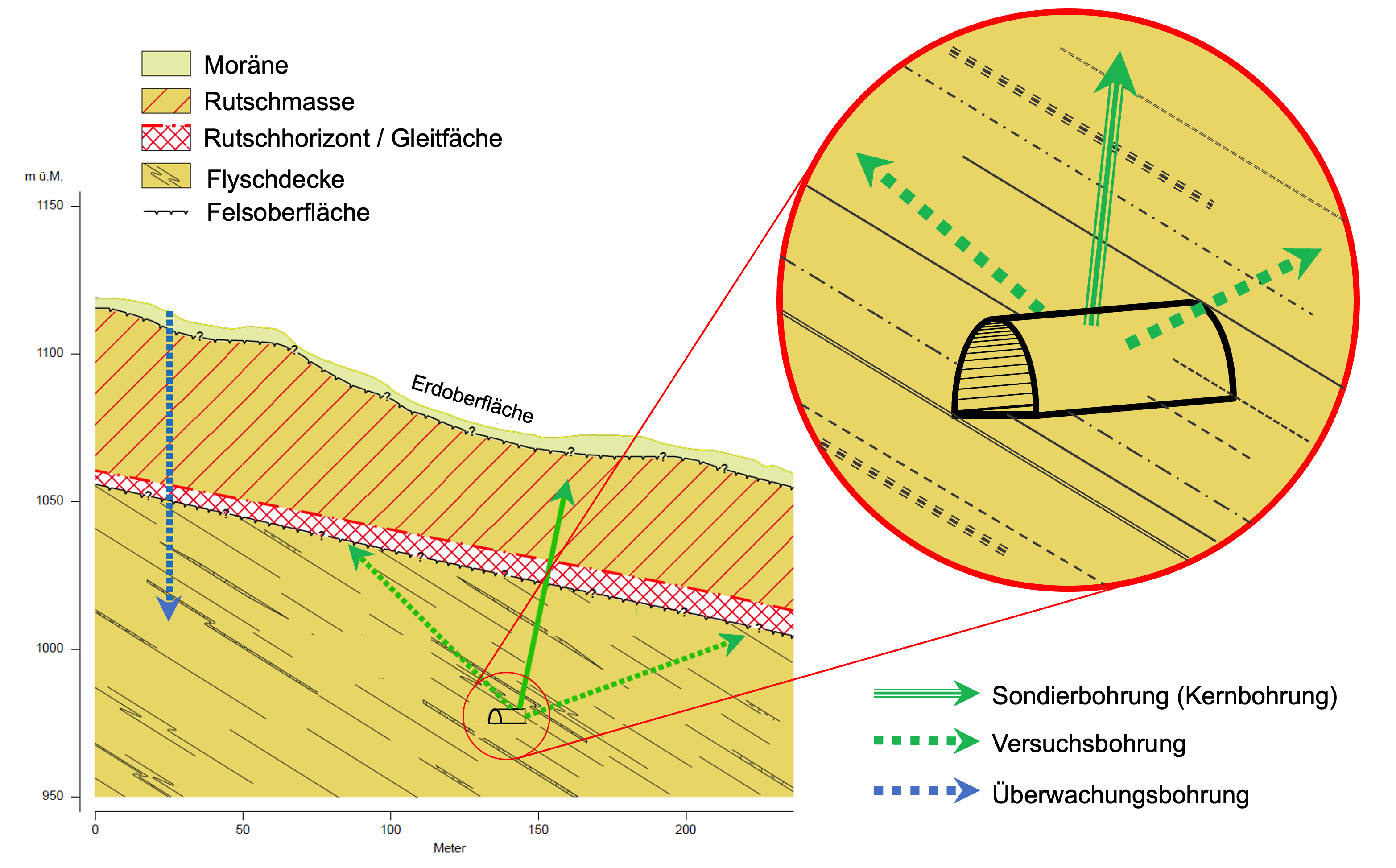
The cleat itself and its size are not necessarily decisive. The special feature of drainage stollen is the drainage holes. This involves drilling out of the tunnel into the stable mountains above and perhaps also into the slippery mass. Water can then drain out of the rock into the tunnels through these holes and thus drain the slide.
Around ten of these holes are planned in the exploratory tunnel. Later, if it is converted into a drainage tunnel, it could be several dozen or even hundreds.
“It is primarily about reducing the pressure of the water in the mountain.”
They therefore allow water to drain out of the mountain. How much water do you have to reckon with? Are there whole streams coming out of the mountain or just a few bathtubs a day?
(thinks and smiles) Predicting mountain water accumulation in underground mining is one of the hardest. The Flyschfels is generally very poorly permeable and water can only be expected in the area of disturbed or cracked rock. We do not know exactly where how many of these zones occur and how pronounced they are. However, based on our experience in other underground structures, we do not expect large amounts of mountain water. However, the sheer amount of water is also not as decisive. It is primarily about reducing the pressure of the water in the mountain.
If the probe tunnel delivers good results, it should be converted into a drainage tunnel as a second step and operated over the long term. What does “good results” mean? What does the exploratory tunnel have to do so that you continue afterwards?
A first goal is to show whether the rock below the landslide and the slippery mass itself can be drained at all. We want to prove that a certain amount of water flows from the mountains into the tunnels. If this runoff also leads to a drop in the water level below or within the landslide, these would be good results.
Critics say that drilling from below is repeatedly demolished because the terrain is constantly shifting. Does that mean that you have to drill and shell out new holes every year?
As a first step, the drilling will probably not be carried out all the way up to the slide, but only in the sturdy rock below. Whether we continue drilling down to the slide later depends on whether the drilling in the sturdy rock is already having an effect and slowing down the landslide as a result. If additional holes have to be drilled into the slide from below, it is possible that they will be torn off first. However, if enough such drilling is carried out and has the desired effect, we expect the sliding movements to slow down or, in the best case, stop. The “lifespan” of such holes therefore depends on how quickly and to what extent we can reduce sliding movements.
Some homeowners fear that the tunnel could lead to land subsidence, which would then damage the houses. Can you calm them down?
It is known that drainage measures can also lead to land formation. For this reason, too, the exploratory tunnel has been planned as far away as possible from the settlement area. Before we start building the exploratory tunnel, the condition of the houses is also assessed by a specialist. During construction, we will then carry out close monitoring measurements. In this way, we can identify any sites at an early stage and take measures if necessary.
Daniel Figi
The geologist/geoengineer went to Brienz Rutsch for the first time in 2011. He has been working with him professionally since 2018. Daniel Figi's job is a combination of strategic planning, field observations, and the evaluation and comparison of data. The models that he and his colleagues create from them enable experts and laypeople to understand the complex relationships in a mountain and a landslide.
Daniel Figi (39) lives in Chur with his family. He likes teamwork and loves the beauty, diversity and (un) predictability of nature.
Christian Gartmann has been the Communications and Media Officer of the Municipality of Albula/Alvra since 2019 in connection with the Brienz slide.