Drones are conquering Swiss airspace. Remote-controlled multicopters are buzzing about residential areas, major events and birthday parties; they deliver medical laboratory samples or packages and measure plots of land. They often pose a serious threat to the safe operation of helicopters and aircraft.
Summer is coming and buzzing all over the air again. But insects aren't the cause, it's remote-controlled drones that seem to reproduce like insects. A whopping 100,000 drones are said to have already been sold in Switzerland. When amateur photographers and filmmakers fly over the neighborhood gardens every evening, the general population is particularly concerned about questions of privacy. For aviation, however, the exploding number of drones is primarily a security issue. Nobody can say how many drones are actually in operation, because there is no registration requirement.
The Federal Office of Civil Aviation has just registered a few dozen devices. “The federal government must act quickly now, otherwise there will be incidents or even disasters,” Martin Candinas is convinced. The Grisons National Council is President of the Swiss Helicopter Association and has submitted a motion to the National Council to Compel the Federal Council to Act. “We are not opposed to drones in general, but companies need clear guidelines and the Federal Office needs the necessary means to continue to ensure safety.”
From toys to large drones
The problem is obvious. A large proportion of drones are sold as toys at bargain prices and their pilots often have no idea where and how they can fly with their high-tech toys without endangering anyone. Even a toy drone weighing 500 grams can incapacitate a helicopter's tail rotor and force it to make an immediate emergency landing or even crash. Drones are therefore a particular risk, particularly for helicopter operations near the ground and away from airfields and heliports.
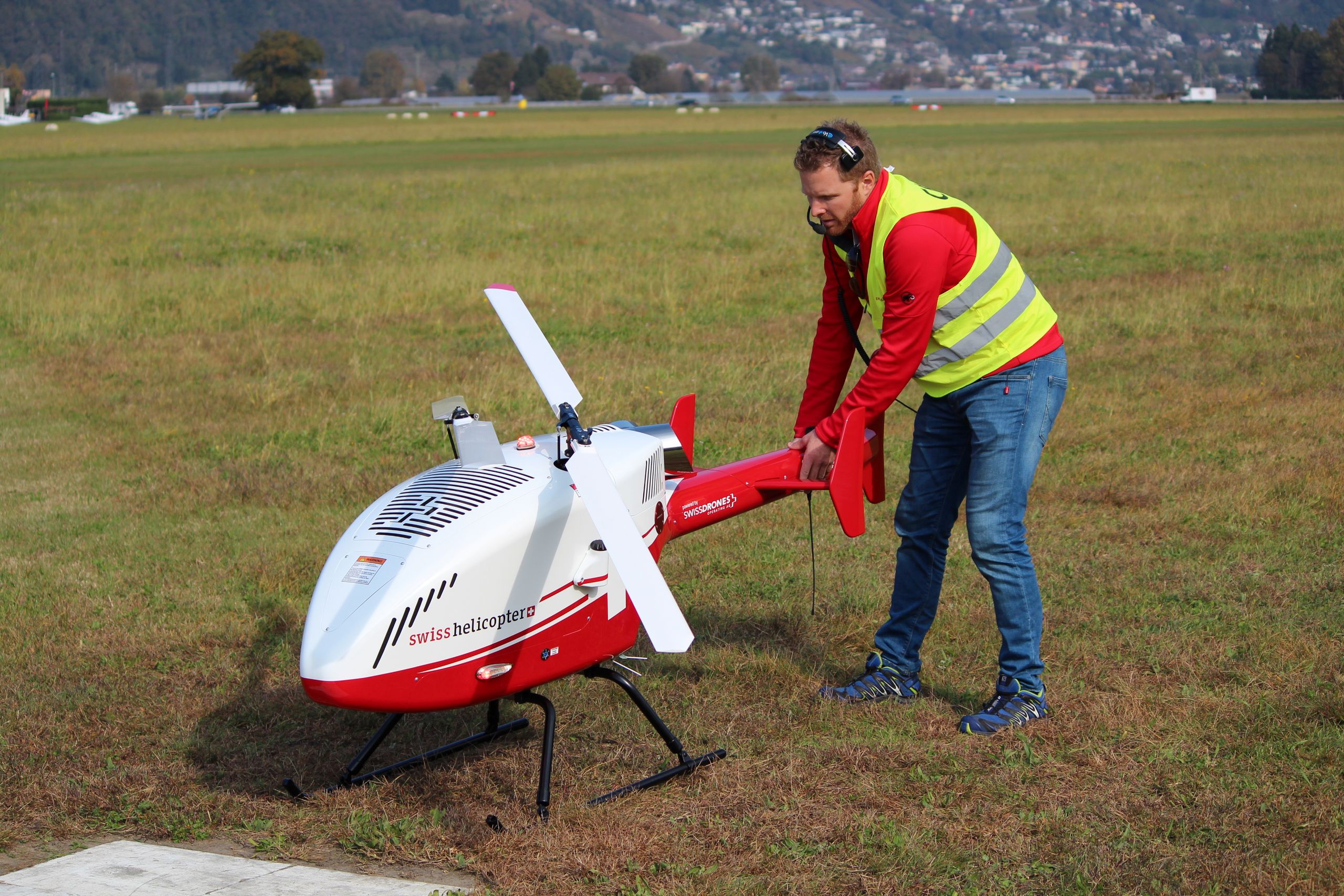
However, the helicopter industry is not fundamentally opposed to drones. Several helicopter companies use drones themselves or cooperate with professional drone operators. Probably the most eye-catching machine is operated by Swiss Helicopters: Their “SDO 50 V2” from Swiss start-up Swissdrones has two rotors with a diameter of almost three meters, is powered by a high-performance turbine and weighs up to 87 kilograms.
“For us, drones are a useful addition to the traditional business model,” says Igor Canepa, base manager in Locarno and project manager for drone operations at Swiss Helicopter. “Our large drone is a system carrier that we use to bring various sensors or cameras into the air. We focus on aviation; the systems come from specialized third-party companies.”
The training of drone pilots is also important to Swiss Helicopters. She regularly conducts courses in Locarno. “There are no requirements or curricula by law. We therefore teach the basics of aviation with its laws, airspaces, weather knowledge and drone technology.” The program is well received: Every two months, around half a dozen drone pilots attend training in Locarno.
According to Canepa, drone pilots should get a feel for flying and thus help to minimize the risks for manned aviation. Clear legal requirements are now necessary: “Where drones are operated commercially, there should also be minimum requirements for pilot training, construction and maintenance of the machines.” However, this left the thousands of toy drones undisturbed.
Digital solution in sight?
“Toy drones aren't the biggest problem at all,” says Ueli Sager, President of the Swiss Association of Civil Drones. Three quarters of the small appliances came from the world market leader DJI and the latter was interested in continuing to sell them legally. However, DJI probably doesn't want to embark on a purely Swiss solution. “Switzerland is a drone country. But it would do well to look for a solution together with the European EASA.”
Skyguide is developing one: Together with Partner Companies, the Swiss Air Traffic Controller is working on so-called U-Space, which is intended to automatically keep drones away from sensitive areas, manned air traffic or other drones. Switzerland is a leader in this area, says Drone Association President Sager.
However, whether and when U-Space will become the European standard remains an open question. EASA is currently working on legal rules that require training for pilots of all weight categories and which should also be adopted by Switzerland. According to media reports, it should primarily cover the legal basis and may also be adopted by Switzerland as early as 2019.
Martin Candinas, however, has reservations about simply joining EASA standard: “EASA treats drones like model airplanes. This does not do justice to model aviation or drone flying and is therefore not a solution. Switzerland needs liberal regulations so that the development and safe operation of drones can continue to develop.” But Candinas is convinced that the use of drones also has its limits. “The helicopter is still not an outdated model.”
plain text
Switzerland is a drone country. The number of drones is increasing rapidly, and no one can even come close to saying how many there are. Uncontrolled deployment also increases the risk of collisions with other aircraft, in particular helicopters, and risks for people, property and critical infrastructure on the ground.
But drones don't just bring dangers. Drones can be a good addition to manned helicopters and airplanes. Their controlled use can certainly make sense in agriculture, healthcare, rescue operations and the measurement and control of important infrastructures. Numerous companies have established themselves in the research, development and manufacture of drones and their applications and have helped our country become an international leader.
All of this and the safety of parts of manned aviation are at stake if drone operations cannot be steered in an orderly manner. However, the responsible federal office lacks both the legal basis and the technical and personnel resources to do so.
Technical solutions for the controlled and safe operation of drones are waiting to be deployed, and Switzerland can also play a leading role here. However, this is only possible if the federal government seeks liberal regulation and leaves sufficient room for technical development. EASA's approach of treating traditional model airplanes and drones equally is not a solution.
The legal basis to force drone owners to train, register and identify or install technical security measures is still missing. The overrun supervisory authority is unable to meet these new challenges or implement effective technical control systems. The Federal Council is called upon to remedy the situation quickly and at the same time to maintain the liberal Swiss regulation.
Martin Candinas, President Swiss Helicopter Association
This article by Christian Gartmann was published in the aviation magazine “Cockpit” (May 2018). It was produced on behalf of the Swiss Helicopter Association (SHA).