Construction has begun for the rehabilitation of the drainage system in the Maiensässe area around Propissi. More than two and a half kilometers of new drainage channels will be built by late autumn. At the construction site, we met construction manager Ivo Thaler.
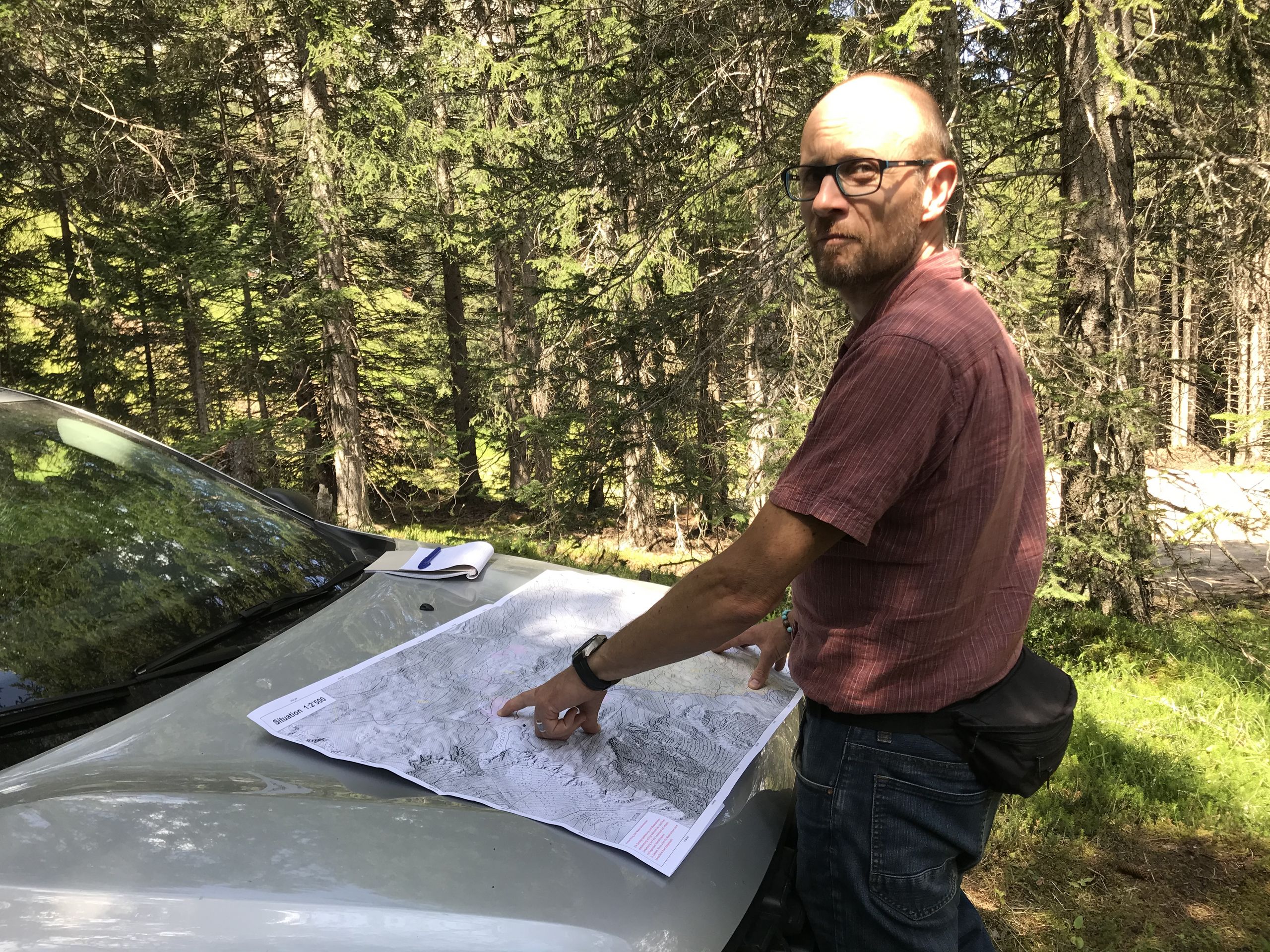
Interview: Christian Gartmann
Preparatory work has begun. Have there been any surprises yet?
Yes, and on the positive side: On the one hand, the good weather helps our work and, on the other hand, we found that the assumptions for our planning were largely correct.
What do you mean “that the assumptions were correct”?
It was important to the municipality and the canton that we carry out the planning and tendering of the work quickly so that we could start construction as early as this summer. The planning was therefore carried out in winter and we were unable to walk every meter of the terrain. Thanks to the good support of local people with their local knowledge and experience, we were still able to plan reliably. On the ground, we can now see that we were right.
“Affect the environment as little as possible”
They work in a very special, very beautiful landscape, which is partially protected. How did this influence planning?
We have environmental construction support (UBB), with whom we coordinate the work beforehand. In this way, we ensure that we interfere with the environment as little as possible and even improve it wherever possible.
How can you improve nature?
It is not nature that we are improving, but the effects that previous construction works had. More than 100 years ago, during the construction of the original system, gutters were partly led through valuable dry meadows.
Over time, shrubs and trees grew around the drainage canals. Some of the vegetation was so thick and the shadows cast by the trees so strong that the dry meadow atrophied or died off. In some cases, actual forest soil was created. We have now freed the gutters from this growth and are carefully building the new drainage system. The dry meadow will probably reach the gutters again soon. In this way, we can improve something through construction.
They replace several kilometers of drainage channels. Are they all being rebuilt?
Yes, the new drainage system is built almost exclusively with a corrugated steel sheet system. However, the location of this system in the countryside is almost identical to that of 1906, which was renovated in 1976. This means that no additional land is claimed. This protects the environment and therefore nature.
And what about the many broken pipes that were installed in the 1970s?
Most stay in the ground. Some still have their function as drains and excavating the remaining pipes would be very complex and we would have to tear up the landscape unnecessarily.
The landscape high above the valley is unique. Do you also notice this or do you particularly see the difficulties of building on rough terrain?
And whether I see the beauty! I've never been to a construction site where there were so many wild animals. Every day I see hares and different types of birds. Propissi is probably the most beautiful construction site in Switzerland!
The path up to Propissi is steep, narrow and dusty. In the next few weeks, large trucks will deliver the half-shells, from which they will then build the drainage channels. How is traffic regulated?
The big trucks drive to Pigni, where we unload the material for the first time. From there, it is then transported to the Propissi area by a much smaller “Unimog” off-road truck. There, the helicopter is then used for fine distribution so that the sensitive meadows and soils are not unnecessarily damaged by travel. The entire logistics process is a challenge. There are only a few intersections on the narrow road.
During construction, you may have to wait up to 20 minutes until the road is clear again.
The municipality has urged the population to refrain from making unnecessary trips to the construction site. But construction site tourism should actually make you happy!
(laughs) Of course it's nice when people are interested! But the access road is really narrow and demanding. When two vehicles meet there, one must drive back to the next intersection and also master tight curves and steep passages backwards.
Any unnecessary vehicle can therefore lead to delays for the entire construction site operation and for residents. We also absolutely want to avoid accidents on this steep terrain. That is why the driving ban on the road is also being checked.
What do the locals say about it, who have their maiensässe up here?
They are very open to us and usually show great understanding. Farmers in particular, who have their meadows and pastures up here, know that access is not easy. They have known their country for generations and have already given us good advice for planning.
The collaboration is very good, I am very happy about that!
Maiensässe mostly get their drinking water from small springs. Won't the drainage system damage them?
Draining a landscape can of course influence existing sources. However, it should be said that at least some of these springs are man-made: In places, a great deal of water escapes from the defective pipes of the old drainage system. This can result in sources that have no natural origin.
Unfortunately, they can also be contaminated by bacteria.
How do you now secure the water supply to the Maiensässe?
In cooperation with the municipality and the owners, we have pre-clarified the supply of the maiensässe. We will now make suggestions as to how we can bring clean water to the wells in front of the houses using simple means. To this end, we are planning smaller water tanks and, where necessary, new pipes to the various wells.
Work began a bit later than planned. Will you still be ready in time?
90 percent of the renewed plant is to be put into operation in late autumn. We will be able to do this if the weather is good and the corona pandemic does not lead to delivery delays or construction stops. Some manufacturing, additional and final work is likely to be completed in the coming year.
About the person
Ivo Thaler (47) is the local construction and construction manager for the rehabilitation of the drainage system in the Maiensässe area around Propissi. The Swiss Dipl. Civil draftsman, mason, foreman and natural and environmental specialist works for the engineering office Eichenberger Revital SA, which specializes in hydraulic engineering and water revitalization. What fascinates him about his work is that he can combine nature with construction. The father of two daughters also likes to spend his free time in nature.
As a ski tourer and mountain biker, he is constantly exploring new parts of Grisons.
The interview was conducted at the end of July 2020 for the monthly information bulletin of the municipality of Albula/Alvra, in which the municipality informs the population about the Brienz slide.
Download
Christian Gartmann is the communications and media officer for the municipality of Albula/Alvra for the Brienz slide.