The “island” slides independently of the rest of the Brienz slide. This is the only way to explain that the entire Brienz slide has slowed down noticeably in recent months, but the island has accelerated significantly. Geologists think it is likely that the island will crash or slide this year.
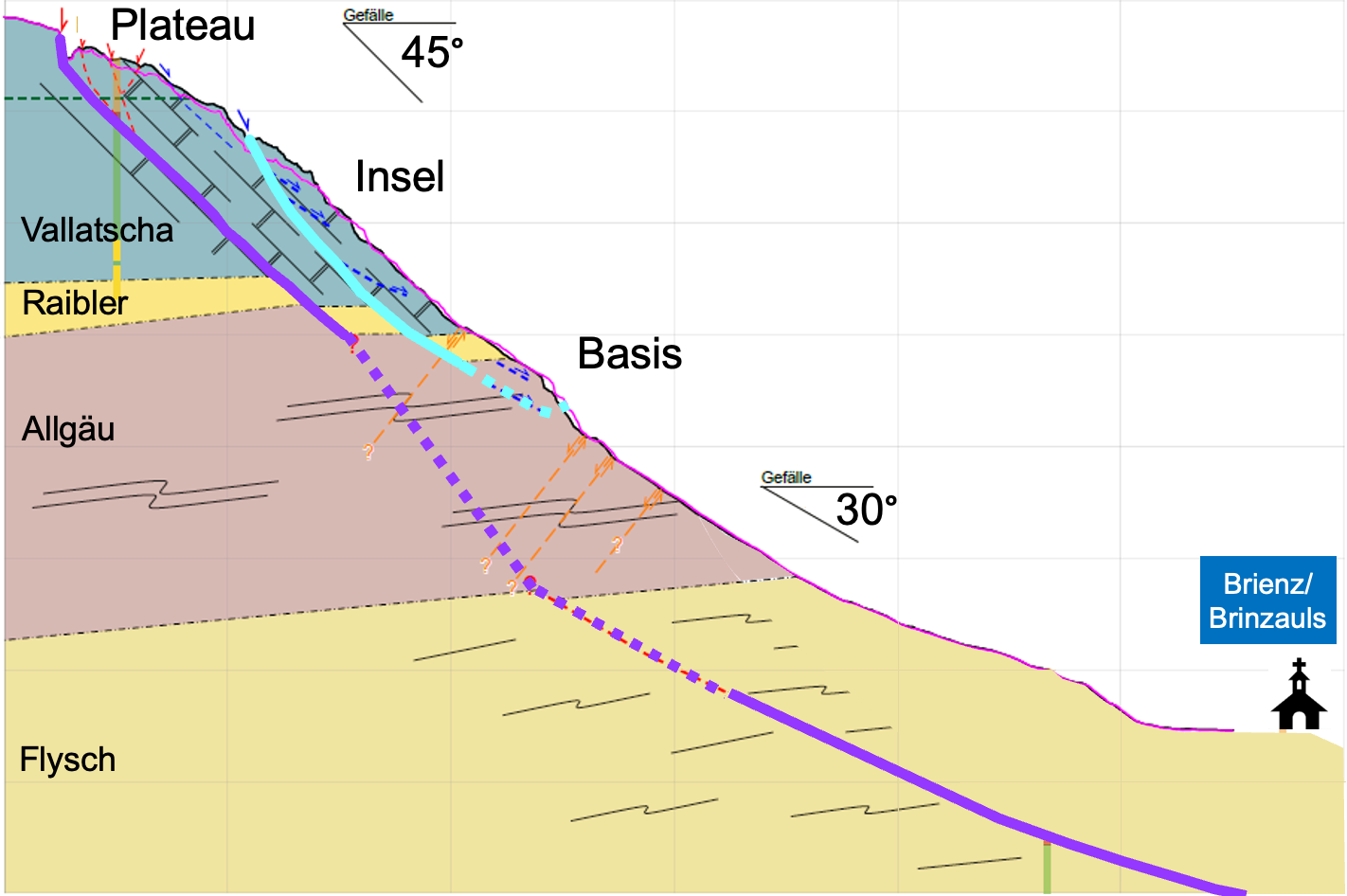
A section through the terrain and the underlying layers shows that the entire Brienz slide is on an almost continuous sliding layer that is up to 150 meters below the terrain. The water pressure under this layer could be reduced by constructing the sounding tunnel. In addition, due to the rather dry weather in 2022, less water has entered the landslide.
High above Brienz/Brinzauls, the island also moves along this large landslide. As a “slide on a landslide,” it also moves on its own, less deep-lying sliding layer.
It is independent of the deeper base layer of the Brienz slide, is very high up in the mountain landslide and can therefore react differently than the entire Brienz slide.
Development of the island
Until last late autumn, movements only increased significantly in the “island” area. Since the beginning of the year, the base of the island has also been increasingly moving. The supporting function of the base for the island above is being lost more and more; there is a risk of “failure” of the base. As a result, the island is likely to slide or crash in whole or in part. For Brienz/Brinzauls, this poses a risk.
It is most likely to fall in several or many rock falls from a few hundred to a few hundred thousand cubic meters of rock material.
Modelling shows that there is a good chance that such rockfalls will only reach the upper end of the village of Brienz/Brinzauls. The probability of rockfalls is estimated at 60 percent.
It is half as likely as rockfalls that the island will slip in a stream of debris. Like a tough mass, the island would slide one or more meters per day. Depending on how much material is moving, a stream of debris can reach the village or even the underlying slopes and cause major damage.
The probability of a debris flow is around 30 percent.
The least likely process is a major rock slide. Depending on the amount of material, he would reach the village or the slopes below it all the way to Albula. The damage to the village and the surrounding area would be very serious. The probability of a rock fall is around 10 percent.
Predictions become more accurate over time
Which of the three processes will take place cannot be predicted until the last moment. On the other hand, experts can use the measurement data from the monitoring systems to determine how much rock mass will fall or slide off. This forecast is becoming more and more accurate as the event gets closer.
The prediction about the time of the event is also becoming more accurate: Today, we can only assume that a slipping or crashing of the island or parts of it will probably happen between early summer and the end of this year.
The closer the event comes, the more precise a prediction of the time of the event becomes.
Because the size and time of the event are becoming more and more precise over time, the evacuation area can also be adapted to the emerging risk.
Christian Gartmann has been a member of the Albula/Alvra community management staff since 2019 and is responsible for communication and media for Brienz Rutsch.